
Ms Matter Newsletter 2026 #1
Turning Complex Standards into Daily Departmental Action
The transition from standards to day-to-day organizational actions is a critical challenge for business survival. We introduce The Translator Mindset, a high-value skill that bridges the gap between quality departments and the rest of the organization.
Learn the four-step systematic process, from deconstructing a Shall statement to defining objective evidence, that transforms complex clauses into clear, departmental work instructions.
Plus, we clarify the essential difference between the proactive Risk-Based Thinking (RBT) mindset and the structured framework of Formal Risk Management (ISO 31000), showing how a risk-aware culture is the prerequisite for operational excellence.
#newsletter
Level Up: Your Quality Roadmap for the Week
We built the ultimate template for assessing risk and opportunity. It’s giving certified chill.
Download the workbook and secure the bag (of compliance).
- $Icon List Item

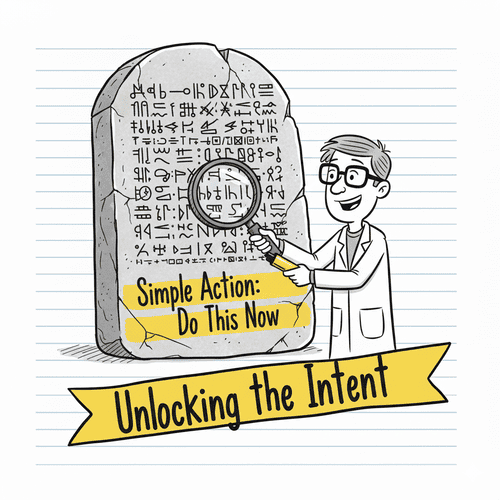
Become a Translator: Turning Complex Standards into Departmental Action
In today’s highly regulated global economy, especially within industries like automotive, aerospace, and medical devices, compliance with complex international standards isn’t just a goal. It’s a fundamental requirement for business survival and success. Standards like IATF 16949 (Automotive Quality Management System), ISO 9001, or AS9100 (Aerospace) are massive, intricate documents. They are written in formal, sometimes ambiguous, language intended to be universally applicable.
This complexity presents a critical challenge for any organization: How do you move from the abstract, high-level requirements in a standard to concrete, practical, day-to-day actions for every employee in every department?
The answer lies in mastering a skill we call The Translator Mindset.

The Crucial Role of the Standard Translator
A Standard Translator is the linchpin that connects the Quality/Compliance department with the rest of the organization, from the engineers designing the product to the logistics team shipping it, and the HR department training the staff.
The Translator’s job is not to copy the standard. It is to interpret the intent behind each clause and express it in the native language of the receiving department. They convert Shall statements into What We Must Do instructions.
For instance, consider the IATF 16949 requirement on Context of the Organization (Clause 4.1):
The organization shall determine external and internal issues that are relevant to its purpose and that affect its ability to achieve the intended result(s) of its quality management system.
To a Quality Manager, this is a planning clause. But to a departmental manager, it’s just jargon.
The Translator’s Output for a Department:
-
For the Engineering Team: Review customer feedback and industry trends (external issues) every quarter to identify new product features or performance improvements needed to meet evolving market expectations.
-
For the Manufacturing Team: Analyze recent internal scrap/rework data (internal issues) monthly to understand systemic production risks that could prevent us from meeting the required delivery/quality targets.
The action is specific, measurable, and directly linked to their daily work, while simultaneously satisfying the high-level standard requirement.

Four Steps to Mastering the Translator Mindset
Becoming an effective Translator requires a systematic approach to breaking down the standard.
1. Deconstruct the Shall Statement
Start by isolating the key components of the clause. Identify the Action (e.g., determine, establish, implement), the Object (e.g., competence, risks, nonconforming output), and the Purpose (e.g., to prevent recurrence, to ensure conformity).
-
Example: ISO 9001, Clause 7.2 – Requirements for Products and Services.
-
Action: determine
-
Object: requirements for the products and services
-
Purpose: to ensure the ability to consistently provide conforming products.
-
2. Link it to an Organizational Process
Every requirement in a standard corresponds to an existing (or needed) organizational process. For the example above, the process is Contract Review/Order Intake. Ask: Which department owns this process? What forms, software, or meetings are already used?
3. Define the Departmental Action (The How)
This is where the magic happens. Convert the formal requirement into a clear, actionable sentence that can be added to a work instruction, procedure, or job description.
-
Formal: Ensure requirements for products and services are defined.
-
Translator Output (for Sales): The Sales team shall use the current ‘Order Review Checklist’ to confirm all customer specifications (including packaging, delivery, and testing) are documented in the ERP system before order approval.
4. Establish the Evidence (The Proof)
A standard is only implemented if there is objective evidence of compliance. The Translator must also define what a compliant process looks like during an internal or third-party audit.
Evidence for the Sales Action: A completed and signed Order Review Checklist attached to the customer’s purchase order, or a screenshot of the confirmed specifications within the ERP system.
Your Next Career Move: From Practitioner to Interpreter
The ability to translate complex standards is a high-value skill that elevates your role from a compliance function to a strategic business enabler. It reduces resistance to change, minimizes departmental friction, and ensures that everyone, from the CEO to the shop floor operator, understands how their daily tasks contribute to the company’s overall quality and compliance success.
Invest in developing this skill. It’s the fastest way to drive true operational excellence.
Risk-Based Thinking (RBT) vs. Formal Risk Management (ISO 31000)
In today’s dynamic business environment, managing uncertainty is not just a best practice. It’s a necessity. You constantly hear terms like risk management, but the concept of Risk-Based Thinking (RBT) has gained significant traction, especially with its integration into modern ISO management system standards like ISO 9001..
But what exactly is the difference between RBT and a full-fledged, formal risk management process like the one outlined in the international standard ISO 31000?
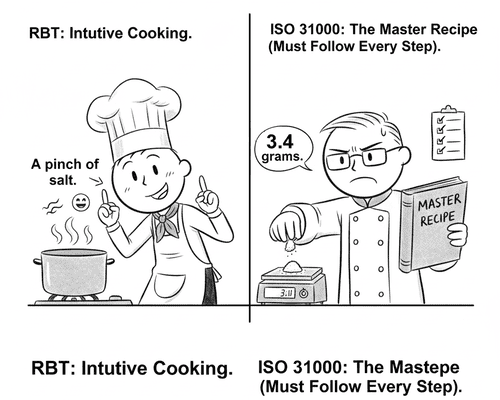
The simple difference is one of scope and formality: Risk-Based Thinking (RBT) is a mindset; formal risk management (ISO 31000) is a detailed, systematic process.
Risk-Based Thinking (RBT): The Proactive Mindset
Risk-Based Thinking is essentially about embedding risk awareness into every decision, process, and activity within your organization. It’s an automatic, continuous way of thinking that asks two fundamental questions at every step:
- What could go wrong? (The Negative Risk, or Threat)
- What opportunities could arise? (The Positive Risk, or Opportunity)
The Key Characteristics of RBT:
- Mindset and Culture: RBT encourages a culture of proactive prevention. It means not waiting for problems to occur (reactive) but anticipating them and designing your processes to minimize negative effects and maximize potential opportunities.
- Integration: It’s not a separate department or activity; it’s integrated into the existing management system. For example, when designing a new product, you inherently consider the risk of materials failure or customer dissatisfaction. That’s RBT in action.
- Flexibility and Simplicity: RBT does not require formal, documented procedures, risk registers, or complex analysis tools (though you can use them). For a small business, a simple discussion about what if before starting a new project is enough to demonstrate RBT.
- Focus: It’s used to ensure your processes achieve their intended results and to drive continuous improvement.
RBT is a systematic, proactive approach to determining, assessing and addressing risk. It should not be a separate component of your management system, rather applied at every stage and by everyone.

Formal Risk Management (ISO 31000): The Structured Framework
ISO 31000, Risk management – Guidelines, provides a structured, principles-based, and systematic framework for managing risks. It is a comprehensive toolset designed to be applied to any type of risk (financial, strategic, operational, etc.) in any organization.
The Key Characteristics of ISO 31000:
- Structured Process: It defines a clear, repeatable, and documented process that typically includes steps like:
- Establishing the Context (defining the scope and criteria).
- Risk Assessment (Identification, Analysis, and Evaluation).
- Risk Treatment (choosing controls and implementing them).
- Monitoring and Review (checking effectiveness).
- Communication and Consultation (ongoing dialogue).
- Formality and Documentation: It is generally a formal process that results in documented information, such as Risk Registers and detailed risk assessments using specific tools (like Failure Mode and Effects Analysis or FMEA).
- Centralized vs. Decentralized: While it can be integrated, it often involves a more centralized function or dedicated risk team to maintain the formal framework and process consistency across the entire organization.
- Scope: ISO 31000 is for organizations that require a robust, auditable, and comprehensive system to manage significant, complex, or highly-regulated risks.
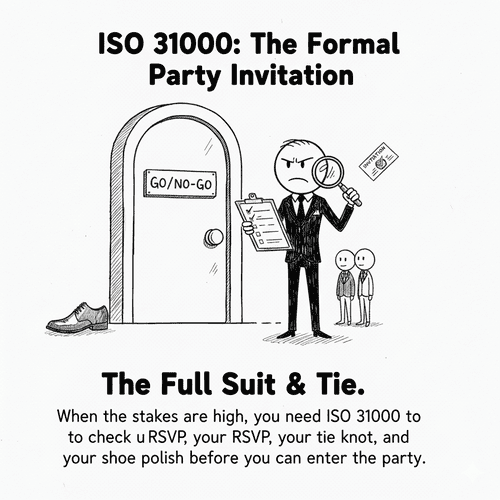
RBT is the entry point, the essential attitude that every employee, from the CEO to the front-line worker, should adopt. ISO 31000 is the detailed, heavy-duty machinery you bolt onto your system when you need to manage risk in a highly structured, enterprise-wide manner.
They are not rivals; RBT is the prerequisite for good risk management. You can’t successfully implement the ISO 31000 process without already having a risk-based culture.

- DOWNLOAD1
- Bridging the Digital Divide: ISO 25556
- ISO 25556:2025 is a new standard, a blueprint for ageing-inclusive digital economies
- Focus on Older Persons: The standard specifically provides requirements and guidelines tailored to ensure the digital economy is inclusive of and beneficial to older persons.
- Universal Applicability: It’s designed for a wide range of stakeholders, including policymakers, administrations, organizations, and consumers, emphasizing the collective responsibility for inclusion.
- Actionable Framework: ISO 25556:2025 specifies principles, aspects, scenarios, and concrete actions necessary to establish or transform existing digital economies to be ageing-inclusive.
- Enhancing Credibility: Adopting these guidelines enhances the applicability and credibility of a digital economy, ensuring it serves all age groups effectively.
- Complements Existing Standards: This document focuses on the economy and inclusion framework and does not duplicate requirements for specific areas like information technology or ergonomics, which are covered by other standards
- More: iso.org
- Mission Control: ISO 5461
- Setting the Standard for Space Systems Failure Reporting, Analysis, and Corrective Action (FRACA).
- Standardizing Reliability: ISO 5461:2025 provides the essential criteria for planning or rating a Failure Reporting, Analysis, and Corrective Action (FRACA) process specifically for space systems.
- Cost-Effective Failure Management: The core objective is to establish capability to collect, process, assess, and eliminate or control failures in a cost-effective manner.
- Mission-Critical Alignment: The FRACA requirements must be commensurate with the product safety or mission severity category and the system’s life cycle product-critical characteristics. This means the rigor of the process scales with the importance of the component.
- Broad Applicability: The standard applies to failures in space, launch, and ground control systems and equipment that occur after qualification (i.e., once the system is deemed operational or ready for flight).
- Stakeholder Responsibility: The requirements apply to all stakeholders contributing to the design, analysis, test, production, and operation of space systems, ensuring comprehensive and integrated failure management across the entire lifecycle, as required by ISO 14300-2.
- More: iso.org
- ISO 22552: The Standard for Manufacturing Readiness Review (MRR) in Space Systems
- Focus on Manufacturing Readiness: ISO 22552:2025 establishes the general requirements for the Manufacturing Readiness Review (MRR) process for deliverable space products.
- Structured Process: The standard defines the complete MRR cycle, covering the initiation process, the detailed implementation process of the review itself, and the necessary activities after MRR (e.g., follow-up actions and documentation).
- Ensuring Product Quality: The primary purpose of the MRR is to assess and confirm that the manufacturing processes, plans, and resources are sufficiently mature and capable to proceed with production, ensuring the quality and reliability of space products.
- Specific Applicability: This document is explicitly applicable to the MRR of deliverable space products, meaning components or systems intended for use in space missions.
- More: iso.org
From static compliance to dynamic, data-driven governance
Your Title Goes Here
Your content goes here. Edit or remove this text inline or in the module Content settings. You can also style every aspect of this content in the module Design settings and even apply custom CSS to this text in the module Advanced settings.
Your Title Goes Here
Your content goes here. Edit or remove this text inline or in the module Content settings. You can also style every aspect of this content in the module Design settings and even apply custom CSS to this text in the module Advanced settings.
Your Title Goes Here
Your content goes here. Edit or remove this text inline or in the module Content settings. You can also style every aspect of this content in the module Design settings and even apply custom CSS to this text in the module Advanced settings.
Your Title Goes Here
Your content goes here. Edit or remove this text inline or in the module Content settings. You can also style every aspect of this content in the module Design settings and even apply custom CSS to this text in the module Advanced settings.
Your Title Goes Here
Your content goes here. Edit or remove this text inline or in the module Content settings. You can also style every aspect of this content in the module Design settings and even apply custom CSS to this text in the module Advanced settings.
Your Title Goes Here
Your content goes here. Edit or remove this text inline or in the module Content settings. You can also style every aspect of this content in the module Design settings and even apply custom CSS to this text in the module Advanced settings.
Wanna know more? Let's dive in!

Developing a Comprehensive Networking Strategy
Developing a strategic networking plan is crucial for career advancement. By setting clear goals, identifying key contacts, and maintaining meaningful relationships, professionals can unlock hidden opportunities, enhance their brand, and foster valuable collaborations that support long-term growth. Networking is an ongoing process essential for sustained career success.

Networking at Events
Networking is essential for career growth. Success lies in preparation, active engagement, and thoughtful follow-up. By mastering these strategies, you can create meaningful connections at any event, opening doors to opportunities and collaborations that can significantly impact your professional trajectory.
Women’s Networking in Engineering
Explore the impact of formal women’s networks in engineering, examining how internal and external networks empower female engineers, provide career support, and foster collective resistance against gender inequality in the profession. It draws on feminist theories of power and recent research findings.

Mastermind Best Practices
Mastermind meetings offer business owners a collaborative space to share insights, solve challenges, and stay accountable. This guide explores best practices for successful mastermind groups, including clear goals, structured agendas, and fostering trust, ensuring participants gain valuable feedback, creative solutions, and long-term growth opportunities.

Five Relational Strategies for Mentoring
We explores five relational mentoring strategies, based on Relational Cultural Theory, to empower women professionals across industries. Emphasizing mutuality, authenticity, and connection, these strategies address power dynamics, foster growth, and build supportive networks, helping women navigate and thrive in their careers.

Coaching and Mentoring: Two Sides of the Same Coin?
Coaching and mentoring, while distinct in theory, often overlap in practice. Both aim to foster personal and professional growth. Context plays a key role in determining which approach is most effective, with organizations blending elements of both to meet diverse developmental needs.

The Professionalization of Mentoring Practices
Unlocking the full potential of mentoring means tackling some key issues head-on, like integrating the latest research, following best practices, understanding the dynamics of mentoring relationships, and aligning goals between mentors and mentees.

Holistic Mentoring Framework
The Holistic Mentoring Framework offers a holistic approach to mentoring, focusing on professional development, emotional well-being, and individualized support. By fostering trust and nonjudgmental relationships, it empowers early career professionals across industries to thrive, promoting continuous growth and addressing their unique challenges.

Best Practices in Mentoring: A Comprehensive Guide
Mentoring is like your personal growth hack. It’s all about connecting with someone who’s been there, done that, and leveling up together. It’s not just career tips – it’s real talk, learning, and support that helps you crush your goals.

ISO 9001 Gets a Glow-Up: Climate Edition
ISO 9001 Goes Green: The iconic quality management standard now includes climate action, pushing businesses to integrate eco-friendly practices. Get ready for a greener, cleaner approach to quality that’s all about saving the planet—one process at a time.

The Path to Resilient Supply Chains: Empirical Insights and Strategic Approaches
As global supply chains become more complex and susceptible to disruptions, businesses must prioritize resilience to maintain stability and performance. This article explores empirical findings and strategic approaches to enhance supply chain resiliency, highlighting the importance of diversification, technology investment, strong supplier relationships, and proactive risk management practices.

Understanding Project Success: Perspectives from Different Stakeholder Groups
Understanding and aligning different stakeholder perspectives is crucial for achieving project success. This study explores how varying interpretations of project success criteria among senior management, project teams, and recipients can lead to project failure. A multiple stakeholder model is proposed to enhance collaboration and reduce the risk of unsuccessful outcomes.